Jingcheng Wang, Zhongguo Guan
State Key Laboratory of Disaster Reduction in Civil Engineering, Tongji University, Shanghai 200092, China
Shaolun Bao, Litao Cheng
CCCC First Highway Consultants Co. Ltd., Shaanxi 710000, China
Contact: 2010045@tongji.edu.cn
Abstract
A powerful earthquake occurred in Maduo, Qinghai Province, China, on May 22, 2021. Bridges at the earthquake-stricken area were damaged or even collapsed. Post-earthquake field investigations of damaged bridges were conducted by the authors during May 28–30, 2021. This is a reconnaissance report on the damage to two typical girder bridges near the epicenter as well as possible damage mechanisms. It is found that the velocity pulse effect of near-fault ground motions could trigger excessive longitudinal displacements and severe pounding of superstructures of long multi-span girder bridges. Abutments could effectively reduce longitudinal seismic damage of short girder bridges through providing sufficient translational restraints.
Keywords: Maduo earthquake; reconnaissance report; damage mechanism; girder bridge; velocity pulse effect; near-fault ground motion; abutment
1 Introduction
An earthquake struck Maduo, Qinghai Province, China, at 2:04\text{am} (local time) on May 22, 2021. According to the China Earthquake Administration (CEA), the magnitude of the Maduo earthquake was M_s 7.4. As the most powerful earthquake occurred in China since the 2008 Wenchuan earthquake, the Maduo earthquake caused damage and even collapse of several bridges near the epicenter, resulting in severe traffic disruptions.
Post-event field investigations on damaged bridges are of great significance, through which damage/failure mechanisms of bridges under seismic loads can be obtained and lessons can be learned for seismic design of bridges in the future. The Maduo earthquake happened at high-altitude cold areas. Seasonally frozen soils and liquefiable soils are detected near damaged bridges. It is important to investigate how bridges located in such complex geotechnical conditions behaved during the earthquake.
A reconnaissance team jointly established by the Institute of Engineering Mechanics of CEA, Tongji University, and Qinghai Earthquake Agency visited the earthquake-stricken area during May 28–30, 2021. In this paper, the damage to two representative girder bridges near the epicenter, Yematan Second Bridge and Heihezhong Bridge, are reported and discussed.
2 Outline of Maduo Earthquake
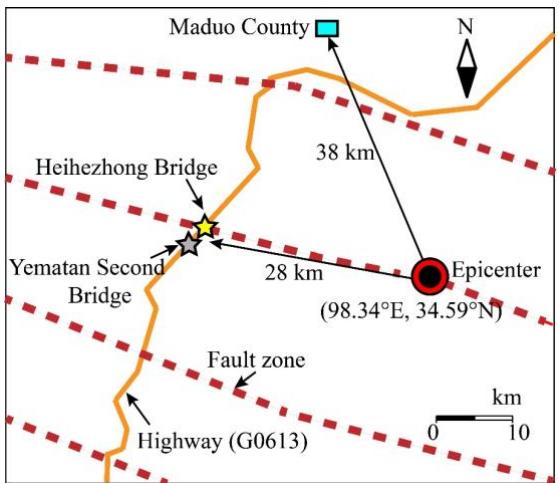
The Maduo earthquake was induced by the rupture of the Kunlun-Jiangcuo fault 1. Figure 1 shows the locations of the epicenter, fault zones, and investigated bridges. The epicenter is located approximately 38\text{km} away from Maduo County at a depth of 17\text{km}. The highway G0631 generally runs from northeast to southwest and crosses many fault zones that trend east-west (EW). The two investigated bridges are quite close to each other and are located near fault zones about 28\text{km} away from the epicenter.
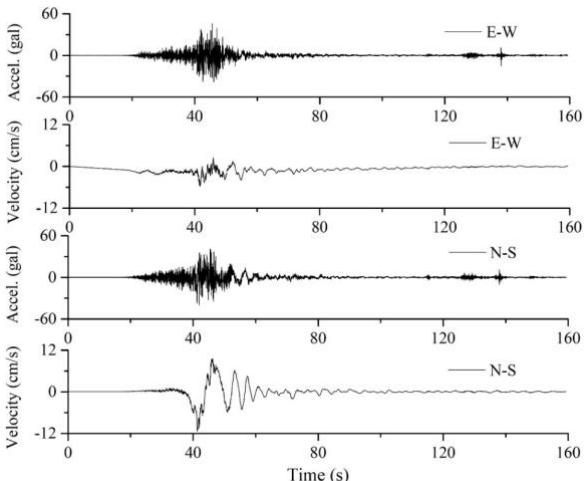
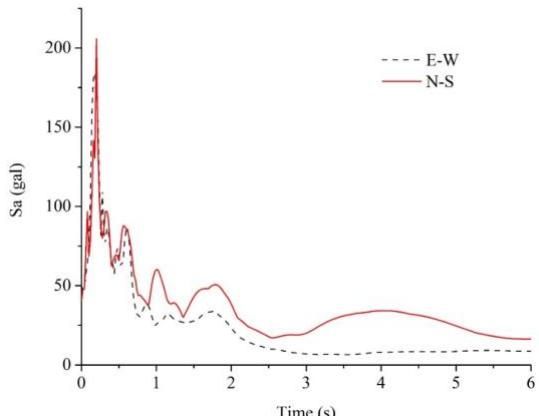
The horizontal ground motions recorded at Dawutai station, the nearest station to the epicenter (175\text{km}), are presented in Figure 2. Figure 3 shows the corresponding 5\% \text{-damped} spectral acceleration (S_a). Significant velocity pulse is observed in the north-south (N-S) component of the recorded ground motion. Besides, compared to the E-W component, the N-S component is found with smaller peak ground acceleration (PGA) but larger spectral acceleration at periods beyond 1\text{s}.
3 Typical Damage of Bridges
3.1 Yematan Second Bridge
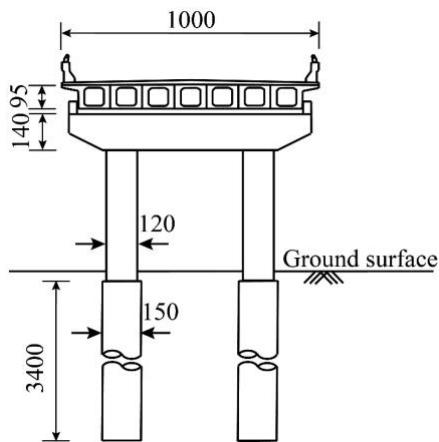
Yematan Second Bridge consists of two separate bridge structures for bidirectional transportation: the upstream bridge is 880\text{-m} in length comprising eleven 4 \times 20\text{m} girder bridges, and the downstream bridge is 900\text{-m} in length comprising nine 5 \times 20\text{m} girder bridges. Figure 4 illustrates a typical bent of Yematan Second Bridge. Prestressed concrete (PC) hollow slab-girders are connected to the continuous deck and simply supported by reinforced concrete (RC) two-column bents with extended pile-shafts through elastomeric bearings. The ground soil consists of loose to dense sandy soils, the upper layers of which are seasonally frozen.
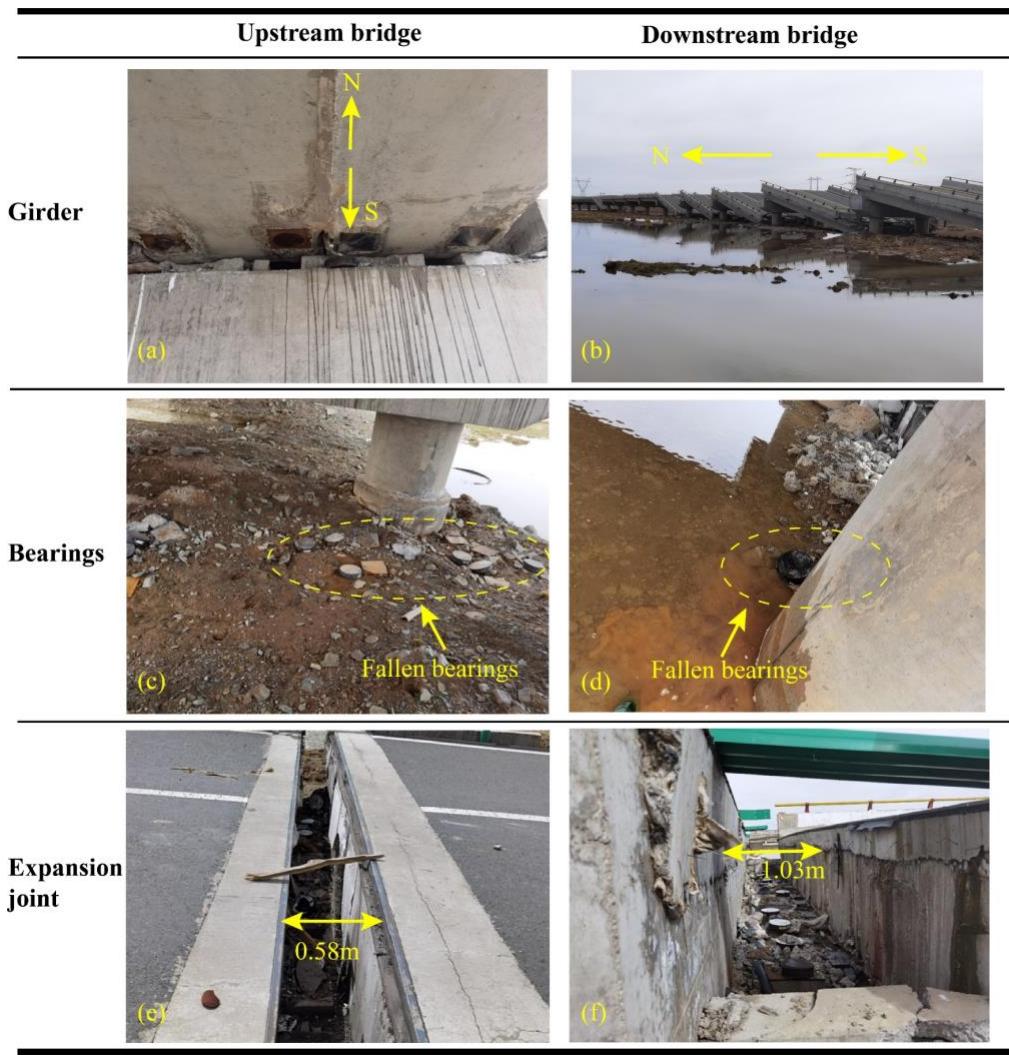
In the longitudinal (N-S) direction, different damage features were observed in girder bridges near the south end (south abutment) and north end (north abutment) of Yematan Second Bridge. Figure 5 shows the damage observed near the south abutment. It was seen that south ends of the upstream bridge girders were about to fall from the support (Figure 5(a)), while south ends of seven downstream bridge girders had fallen to the ground (Figure 5(b)). Bearings supporting these girders were moved out from their positions and fell to the ground (Figure 5(c)(d)). The gap width of expansion joints between the south abutment and girder in the upstream bridge and downstream bridge is up to 0.58\text{m} and 1.03\text{m} (Figure 5(e)(f)), respectively. Other components of girder bridges near the south abutment, e.g., pavement and substructures, kept almost intact. Clearly, Yematan Second Bridge suffered extremely large longitudinal (northward) displacements of bridge decks.
Figure 6 shows the damage observed near the north abutment. Seen from Figure 6(a)(b), the deck displacement near the north abutment is much smaller than that near the south abutment.
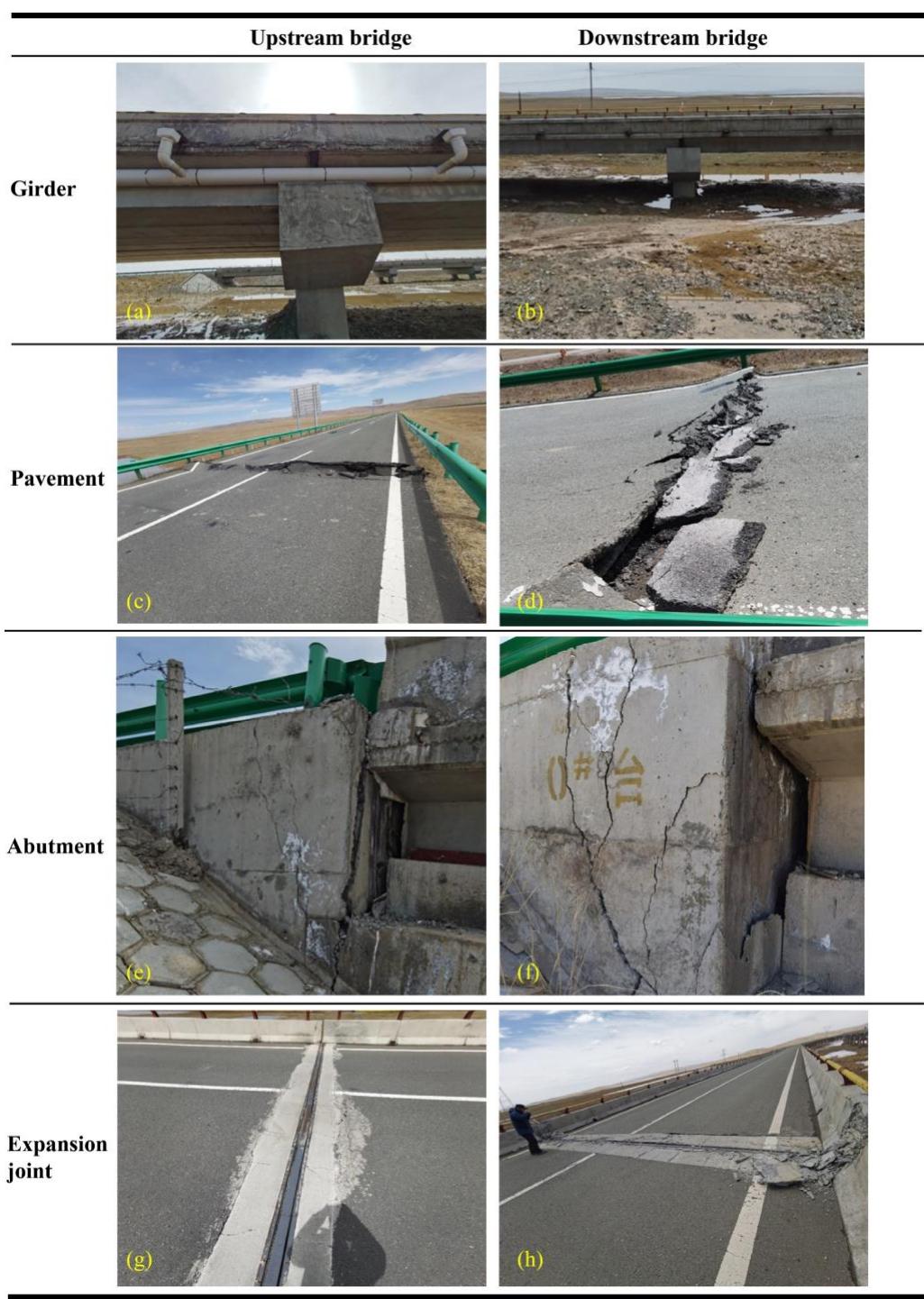
Additionally, it was found that from the north to south, deck displacements of girder bridges gradually increased. Figure 6(c)(d) display the damage to pavement at the end of north abutment approach slabs. The extrusion deformation of the pavement was about 0.3\text{m}, which was induced by collisions between the girder and north abutment. Such severe collisions also caused concrete cracking and spalling of the north abutment (Figure 6(e)(f)). Besides, collisions occurred between adjacent girder bridges, leading to the closure of expansion joints and concrete cracking/spalling of pavement near them, as shown in Figure 6(g)(h).
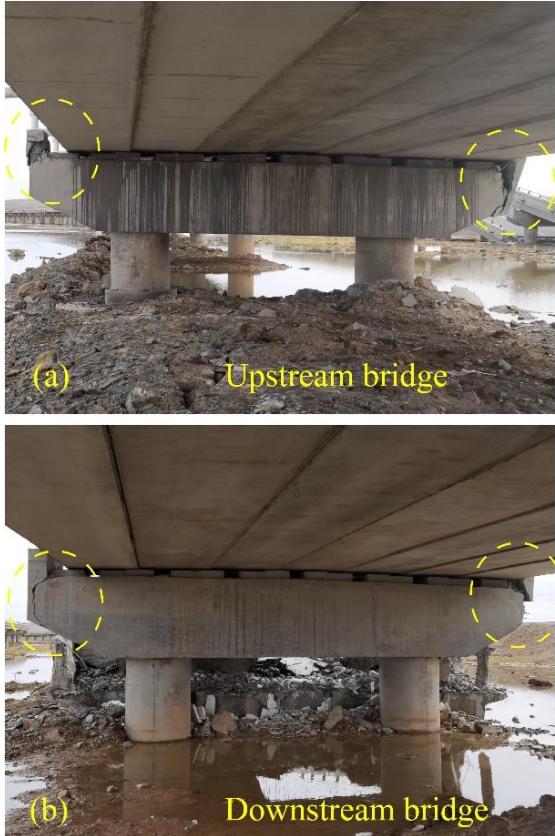
In the transverse (E-W) direction, side blocks were installed at both sides of girders to restrict their lateral translations. Figure 7 displays the post-earthquake state of side blocks. Cracking and spalling of concrete implied that the side blocks worked during the earthquake. No other damage was found in this direction. Apparently, damage in the transverse direction was less severe than that in the longitudinal direction.
3.2 Heihezhong Bridge
Heihezhong Bridge is located about 2\text{km} away from Yematan Second Bridge. It also consists of two separate girder bridges for bidirectional traffic, both of which comprise three 20\text{-m} spans. The girders and bents of Heihezhong Bridge are similar to those of Yematan Second Bridge. However, high damping rubber bearings are adopted instead of the regular elastomeric bearings installed in Yematan Second Bridge.
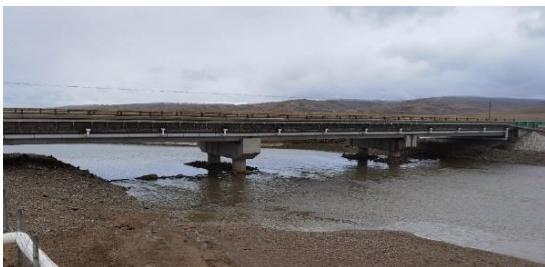
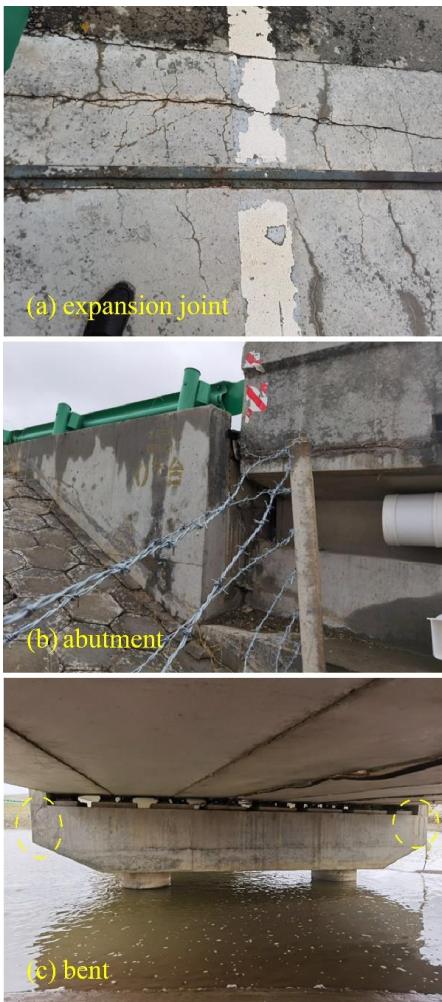
Figure 8 shows the post-earthquake state of Heihezhong Bridge. It was found that the bridge was still serviceable without collapse of spans and severe damage of bridge components. Figure 9 displays damage observed in Heihezhong Bridge. Merely slight concrete cracks were found at expansion joints, abutments, and side blocks, induced by minor collisions occurring in the longitudinal and transverse directions. Bridge bents were almost intact. In general, Heihezhong Bridge behaved satisfactorily during the earthquake.
4 Discussions on Failure Mechanism
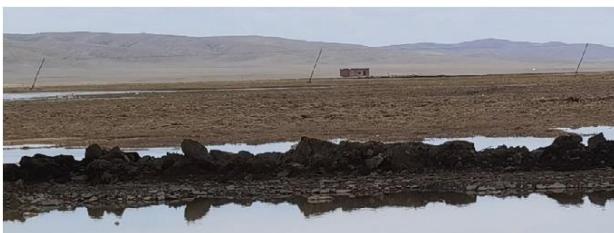
Severe damage of Yematan Second Bridge may be attributed to the velocity pulse effect of near-fault ground motions, as observed in recorded ground motions presented in Figure 2. Specifically, velocity pulses may instantaneously produce significant southward ground displacements, leading to northward relative displacements of bridge girders. Figure 10 shows the post-event state of telegraph poles near Yematan Second Bridge. Tilted telegraph poles indicated significant permanent ground deformations, which generally resulted from much larger instantaneous ground deformations. Due to translational restraints provided by north abutments, girders near north abutments suffered less displacement but more severe pounding damage. The displacements of girders near the south abutment were extremely large, completely exceeding the displacement capacity of bearings and the seat length of girders, resulting in unseating of girders. Compared to the downstream bridge, the upstream bridge is less damaged. Different magnitudes of damage between the two bridges may be attributed to the difference in bridge deck length (i.e., 80\text{m} vs. 100\text{m}) and differences in ground motion inputs due to local soil liquefaction, which was observed in regions between the upstream and downstream bridges.
As for Heihezhong Bridge, the satisfying seismic performance should be attributed to the translational restraints provided by abutments rather than the isolation effect of high damping rubber bearings. More specifically, it was found that the gap width of expansion joints between abutments and girders was quite small. In this regard, the longitudinal behavior of the short three-span bridge was similar to that of integral bridges, i.e., the superstructure basically kept synchronous movement with the ground. In other words, relative displacements of girders were negligible, and the contributions of isolation bearings were thus quite limited. When abutments and backfill can overcome the inertial force of the superstructure, the longitudinal seismic demands of bridges are very small.
Additionally, it can be concluded from the damage of investigated bridges that for ground motions near bridge sites, the intensity of the N-S (longitudinal) component was much higher than that of the E-W (transverse) component.
5 Lessons Learned from the Post-Earthquake Reconnaissance
The velocity pulse effect of near-fault ground motions is not considered in current seismic design practice in China 2. It has been reported in several studies 3,4 that velocity pulses significantly increase permanent deformations of structures and the probability of collapse. The damage to Yematan Second Bridge provided solid evidence of the adverse effects of velocity pulses, which should be carefully considered for seismic design of bridges within a certain range from active faults (e.g., 6\text{miles} recommended by AASHTO 5) in the future. Additionally, for near-fault long multi-span bridges, unseating prevention practices should be employed, including providing sufficient seat length, connecting adjacent decks, connecting decks and substructures, strengthening anchor bolts of bearings, and so on. The collapse of Yematan Second Bridge could have possibly been prevented if unseating prevention devices were provided. Moreover, the longitudinal inertial force of the superstructure is commonly designed to be overcome by bridge bents 2. However, the excellent seismic performance of Heihezhong Bridge indicates that the impacts of abutments on longitudinal seismic demands should be incorporated, especially for girder bridges with limited span number and length.
6 Conclusions
This paper reports the damage to Yematan Second Bridge and Heihezhong Bridge during the Maduo earthquake. The main findings are summarized below:
- Yematan Second Bridge suffered from excessive longitudinal displacements of girders, which resulted in the collapse of spans and severe girder-girder and girder-abutment collisions. Such extremely large girder displacements may be attributed to the significant ground deformations induced by the velocity pulse effect of near-fault ground motions.
- Heihezhong Bridge behaved satisfactorily during the earthquake, which can be attributed to the translational restraints provided by abutments.
- For seismic design of near-fault bridges in the future, velocity pulses should be carefully considered and unseating prevention devices/practices should be employed, especially for long multi-span girder bridges. Besides, contributions of abutments in reducing longitudinal seismic demands should be well considered, especially for short girder bridges.
It should be noted that findings of this study are based on damage features of investigated bridges, ground motion records, and the authors' engineering judgments. Rigorous numerical and experimental studies are required in the future to support these findings and further reveal the seismic behavior and failure mechanisms of the investigated bridges.
7 References
Pan J., Bai M., Li C., Liu F., Li H., Liu D., et al. Coseismic surface rupture and seismogenic structure of the 2021-05-22 Maduo (Qinghai) Ms 7.4 earthquake. Acta Geologica Sinica. 2021; 95(6): 1655–1670. ↩
Ministry of Communications of the People's Republic of China. Specifications for Seismic Design of Highway Bridges. Beijing, China; 2020. ↩ ↩
Hutchinson T.C., Boulanger R.W., Chai Y.H., and Idriss I.M. Inelastic seismic response of extended pile shaft supported bridge structures. Pacific Earthquake Engineering Research Center; 2002; PEER Report: 2002/14. ↩
Kohrangi M., Vamvatsikos D., Bazzurro P. Pulse-like versus non-pulse-like ground motion records: Spectral shape comparisons and record selection strategies. Earthquake Engineering Structural Dynamic. 2019; 48(1): 46–64. ↩
AASHTO. AASHTO LRFD bridge design specifications. 6th ed. Washington, D.C.: American Association of State Highway and Transportation Officials (AASHTO); 2012. ↩